April 11, 2026
Salt Damage on Concrete Driveways: What Hamilton Homeowners Need to Know
Road salt causes more long-term damage to concrete driveways in Southern Ontario than any other single factor. Most homeowners know salt is hard on concrete. What many do not fully understand is how the damage actually happens, why it accelerates so quickly on unprotected surfaces, or that their driveway is being exposed to salt even when they never apply it themselves.
At A.D.S. Wash & Seal, we see the effects of salt damage on residential and commercial driveways across Hamilton, Ancaster, Burlington, Waterdown, Dundas, Stoney Creek, Grimsby, and Beamsville every single season.
How Road Salt Damages Concrete
Concrete is a porous material. It absorbs moisture, and that moisture travels deeper into the slab than most people realize. Salt changes how that moisture behaves in a way that is particularly destructive in a climate like Hamilton’s.
Under normal conditions, water freezes at 0 degrees Celsius. Salt lowers that freezing point. On a salted surface, water remains liquid at temperatures where it would otherwise freeze, then freezes and expands as temperatures continue to drop further. This means the moisture penetrates deeper into the concrete before it turns to ice — and when it does freeze, it expands with more force than unsalted water would.
Hamilton’s position at the western end of Lake Ontario amplifies this problem. Lake-effect weather patterns mean temperatures swing above and below freezing repeatedly throughout winter, sometimes within the same week. Each swing is another freeze-thaw cycle. Each cycle forces the concrete to expand and contract. Over a full season, the cumulative effect breaks down the surface from the inside out.
The Source of Salt Most Homeowners Miss
Many homeowners in Hamilton do not apply salt to their driveways at all. Their driveways still get damaged by salt.
Every time you drive on a salted municipal road during winter, salt and brine accumulate on the underside of your vehicle. When you pull into your driveway, that salt-saturated slush and water drips directly onto the concrete surface. As temperatures fluctuate, that water soaks in and the freeze-thaw cycle begins.
This is why the worst pitting and erosion often appears in the centre of driveways and in the wheel tracks — the exact areas where vehicles park and idle — even on properties where no salt was ever deliberately applied.
What Salt Damage Looks Like
Salt damage progresses through recognizable stages. Catching it early makes a significant difference in what can be done about it.
White Haze on the Surface
A white or chalky haze across the driveway surface is often the earliest visible sign. This is salt residue crystallizing on the surface — a chemical reaction to the salt exposure. At this stage, professional cleaning can remove it. Once the residue is cleaned off and the surface is sealed, further crystallization is significantly reduced.
Surface Pitting
Small pits or holes forming across the surface are typically the next visible sign. The concrete begins to look rough and pockmarked rather than smooth. Pitting is most common in areas with the highest salt concentration — the centre parking area, the wheel tracks, and the apron near the road.
Spalling
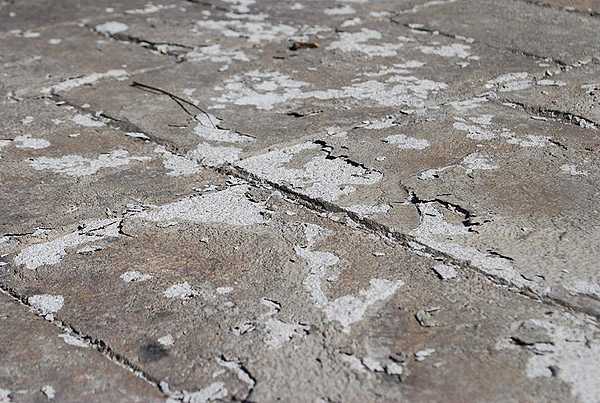
Spalling is the flaking and breaking away of the top layer of concrete. It appears as shallow, irregular patches where the surface has separated and come off. Once spalling begins it tends to spread, as the newly exposed concrete underneath is even more vulnerable than the original surface was.
Spalling is particularly damaging on stamped concrete. The colour and pattern sit in a surface layer — when salt eats through that finish, it exposes plain concrete underneath with no colour and no protection. When we seal stamped concrete that has spalled areas, we apply a pre-coat to those exposed sections so they receive three coats total rather than two.
Surface Scaling
Scaling appears as roughening or flaking across larger areas. On exposed aggregate driveways, scaling weakens the bond holding the decorative stones in place and causes them to loosen and come free. On stamped concrete, advanced scaling can remove the finish across broad sections, leaving the driveway looking patchy and worn.
Which Surfaces Are Most Vulnerable
New Concrete in the First Two Winters
Freshly poured concrete is particularly vulnerable while it is still gaining full strength. The right approach is to apply a cure and seal product once the concrete has cured for 28 days, then maintain it consistently from that point forward.
Stamped Concrete
Stamped concrete is the most vulnerable surface type in a frost climate. Its decorative finish is a surface layer, not a material that runs through the full depth of the slab. Prevention through regular sealing is not just beneficial — it is essential.
Exposed Aggregate
The decorative stones and the surrounding concrete matrix expand and contract at different rates. Salt accelerates this process, gradually weakening the bonds that hold the stones in place until they begin to pop out.
Standard Broom Finish Concrete
The most common driveway surface across Hamilton and surrounding communities. Highly susceptible to pitting and spalling when left unsealed over multiple winters. The damage compounds steadily year over year.
Can Salt Damage Be Reversed?
The honest answer depends on how far the damage has progressed.
What professional cleaning and sealing can do:
- Remove salt residue and white haze from the surface
- Improve the appearance of lightly and moderately damaged concrete
- Seal the surface to prevent further salt and moisture penetration
- Slow or stop the progression of existing damage
- On spalled stamped concrete, additional coats can build up protection on the most vulnerable areas
What sealing cannot do:
- Rebuild concrete that has already flaked or spalled away
- Repair structural cracks without additional work
- Reverse advanced spalling or restore original colour once significant surface loss has occurred
When we pull up to a driveway and see widespread spalling combined with structural cracking, we give the homeowner an honest assessment. If the surface can be meaningfully improved and protected, we say so. If it is beyond what restoration can address, we say that too.
How to Protect Your Concrete Driveway from Salt Damage
Seal the Surface
Professional sealing creates a barrier that significantly reduces how deeply moisture and salt can penetrate. Most Hamilton driveways benefit from resealing every 2 to 3 years. Staying on a consistent schedule is far more cost-effective than waiting until damage is visible.
Rinse Your Driveway in Spring and Through Summer
Once temperatures rise above freezing in spring, rinse your driveway to remove the salt residue that has accumulated over winter. We recommend rinsing roughly once a month through the summer season. A garden hose is enough — the goal is simply to keep salt residue from continuing to react with the concrete surface between professional maintenance visits.
Use Sand Instead of Salt for Traction
Sand provides grip without the chemical reaction that accelerates freeze-thaw damage. It is a safer choice for concrete surfaces than salt.
Leave a Mason Jar for Hairline Cracks
For driveways with hairline cracks, we sometimes leave a small jar of sealer with the homeowner after the job is done. Before winter arrives, they can apply a little extra into those cracks themselves as an added layer of protection.
Our Don’t Pay Until You’re Satisfied Guarantee
Every job we complete at A.D.S. Wash & Seal is backed by our Don’t Pay Until You’re Satisfied guarantee. We do not take deposits. We complete the work, and then we ask for payment.
After 15 years working on properties across Hamilton, Ancaster, Burlington, Waterdown, Dundas, Stoney Creek, Grimsby, and Beamsville, that guarantee reflects how we approach every job.
When to Call a Professional
It may be time to have your driveway assessed if you notice any of the following:
- White haze or chalky residue across the surface
- Water soaking into the concrete rather than beading off
- Visible pitting or roughening of the texture
- Patches where concrete has flaked or come away
- Cracks that have widened since last season
- Exposed aggregate stones loosening or missing
- Faded or uneven colour on stamped or decorative concrete
- It has been more than 2 to 3 years since the last professional seal
Get a Free Estimate
If your driveway is showing signs of salt damage or has not been sealed in the past few years, now is the right time to assess the surface before the next winter season.
Call us at 905-515-2992 or visit our contact page to book your free estimate. Every job is backed by our Don’t Pay Until You’re Satisfied guarantee.
Frequently Asked Questions
Does road salt always damage concrete?
Salt significantly accelerates deterioration on any concrete surface, especially in climates with frequent freeze-thaw cycles like Hamilton. Sealed surfaces are not immune, but sealing dramatically reduces how much salt and moisture penetrate.
How long does it take for salt damage to appear on a driveway?
On unsealed driveways, visible signs like white haze, surface roughening, and early pitting can appear after two to three winters — sometimes sooner depending on salt exposure levels and how new the concrete is.
What is the white haze on my concrete driveway?
The white or chalky haze is salt residue crystallizing on the surface — a chemical reaction to ongoing salt exposure. Professional cleaning can remove it, and sealing after cleaning prevents it from returning as quickly.
Can damaged concrete still be sealed?
Yes, in most cases. For lightly and moderately damaged concrete, cleaning and sealing can significantly improve appearance and stop further deterioration. For severely spalled or structurally cracked concrete, we assess the situation honestly during the estimate.
Is sand safer than salt for concrete driveways?
Yes. Sand provides traction without the chemical reaction that accelerates freeze-thaw damage — particularly important for stamped or decorative surfaces.
Why does the worst damage appear where my car parks?
Every time you drive home in winter, salt and brine from municipal roads accumulate on the underside of your vehicle and drip onto the driveway surface. The centre and wheel track areas receive repeated concentrated salt exposure throughout the season even if you never apply salt yourself.
What is your Don’t Pay Until You’re Satisfied guarantee?
We do not take deposits. We complete the full job and then ask for payment — you inspect the work before any money changes hands.
Is there a concrete washing and sealing company near me serving Ancaster, Burlington, and Waterdown?
Yes. A.D.S. Wash & Seal services the full region including Hamilton, Ancaster, Burlington, Waterdown, Dundas, Stoney Creek, Grimsby, and Beamsville. Contact us to book a free in-person estimate.