March 14, 2026
Concrete Sealing Hamilton: Protect Your Driveway, Patio & Interlock
Concrete and interlock surfaces are designed to last for decades. But in Southern Ontario — and specifically in Hamilton and the surrounding area — these surfaces face conditions that few other regions in Canada match for sheer aggression.
Freeze-thaw cycles, road salt, moisture, lake-effect weather patterns, and UV exposure work together year-round to break down unprotected surfaces. The damage is gradual at first — easy to ignore. But once it takes hold, it spreads quickly and becomes expensive to address.
At A.D.S. Wash & Seal, we have been cleaning and sealing concrete and interlock surfaces across Hamilton, Ancaster, Burlington, Waterdown, Dundas, Stoney Creek, Grimsby, and Beamsville for over 15 years. Professional sealing is one of the most cost-effective things you can do to extend the life of your driveway or patio.
Why Hamilton’s Climate Is Hard on Concrete
Hamilton sits at the western end of Lake Ontario. That location exposes the area to lake-effect moisture patterns that amplify the freeze-thaw cycle more than many other parts of the province experience. Temperatures swing above and below freezing repeatedly throughout winter — sometimes within the same week.
Every time moisture gets into concrete and freezes, it expands. Every time it thaws, it contracts. Repeated over an entire season, this cycle gradually breaks the surface down from the inside out.
Add road salt into that equation — applied heavily on Hamilton roads throughout winter — and the deterioration accelerates. Salt lowers the freezing point of water, which actually increases the number of freeze-thaw cycles the concrete experiences. It also reacts chemically with concrete over time, weakening the surface layer.
One thing many homeowners do not realize: road salt does not just come from the street. Every time you drive home in winter, your vehicle carries salt residue with it. As snow melts off the undercarriage, saltwater drips directly onto your driveway and sits there. Without a sealer acting as a barrier, that salt is absorbed into the concrete and begins doing its work.
How We Show Homeowners What Is Happening
When we visit a property for an estimate, we will sometimes pour water directly onto the driveway and ask the homeowner to watch. The concrete darkens almost immediately as the water absorbs into the surface.
Two things happen in that moment. First, the driveway looks noticeably better — the colour is richer, the surface more vibrant. Second, the homeowner understands exactly what is being absorbed every time it rains or snows. Salt, moisture, contaminants — all of it going straight in.
The reaction is almost always the same: “You know what, it really does look great when it rains.” That is exactly what we tell them a sealed driveway looks like all the time.
The Right Sealer for Your Surface
Not all surfaces require the same product. We use different products depending on the surface type.
Standard Grey and Broom Finish Concrete
For standard grey concrete and broom finish driveways, we use a penetrating hydrophobic sealer. This product is absorbed directly into the concrete rather than forming a film on top. It does not change the appearance of the surface at all. Think of it like spraying a waterproofing product on a pair of shoes — water and contaminants bead off the surface rather than soaking in.
Decorative Concrete: Stamped, Exposed Aggregate, and Coloured Surfaces
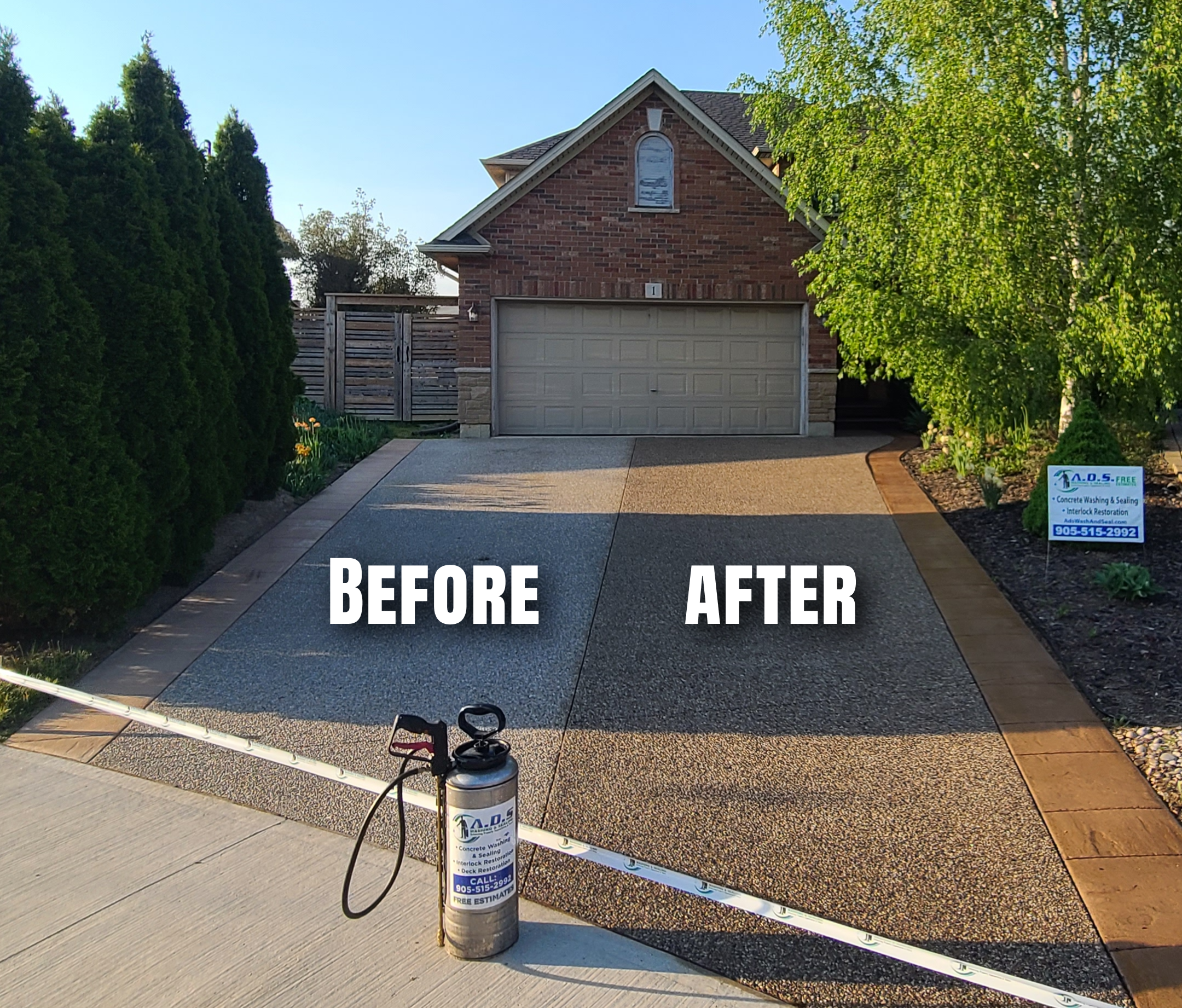
For decorative concrete washing and sealing, we use a film-forming sealer specifically formulated for decorative applications. This sealer enriches the colour of the concrete — the way a wet stone looks richer than a dry one. We apply two coats plus our non-slip Shark Grip additive.
New Concrete
Fresh concrete needs 28 days to fully cure before anything is applied. Once that window has passed, we wash the surface and apply a cure and seal sealer — a product specifically formulated for post-pour concrete.
What the Process Looks Like
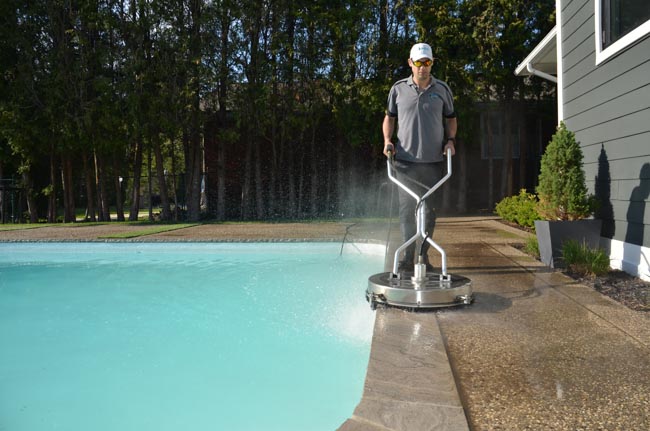
Every job starts with a proper clean using our truck-mounted industrial pressure washer with a surface cleaner attachment. The surface cleaner gives us full control over the pressure being applied — we can dial in the right cleaning power without risking damage to stamped patterns, exposed aggregate, or older concrete.
When staining requires more than pressure alone, we apply appropriate chemical treatments before washing. The goal is a clean, fully prepared surface before any sealer goes on. Sealing over a dirty surface traps the problem underneath.
Once the surface is clean and fully dry, we apply the appropriate sealer for that surface type. Two coats where applicable, with non-slip additive included as standard.
Common Concrete Damage We See Across Hamilton
Salt Damage and Pitting
Salt damage is the most common issue we see on driveways across Hamilton, Ancaster, Dundas, and Stoney Creek. The pitting starts small — easy to overlook in the first couple of seasons — and then spreads. A sealed surface significantly reduces how much salt and moisture the concrete absorbs.
Flaking and Spalling
Both stamped concrete and standard broom finish are vulnerable to surface flaking, also called spalling. Once spalling begins, it spreads quickly on an unprotected surface. Prevention is far more effective than repair.
Exposed Aggregate Stones Coming Loose
With exposed aggregate driveways, the decorative stones can begin to loosen and fall out over time. Salt and minerals penetrate beneath the stones and weaken the bond. A film-forming sealer helps hold remaining stones in place while blocking the moisture and salt causing the loosening.
Fading and Discoloration
UV exposure, dirt, and weathering slowly dull concrete surfaces over time. Professional cleaning followed by sealing restores the colour significantly. For decorative concrete, the colour enrichment from a film-forming sealer often makes it look better than new.
Existing Cracks: What We Do
Yes, we seal concrete that has existing cracks. Hairline cracks and minor cracking are common and do not prevent sealing from being effective.
One thing we do that most companies don’t: for hairline cracks, we sometimes leave a small mason jar of sealer with the homeowner after the job. Before winter arrives, they can apply a little extra sealer directly into those cracks as added protection.
For larger cracking, we assess the situation during the estimate and give an honest recommendation about what sealing can and cannot address.
Interlock Sealing
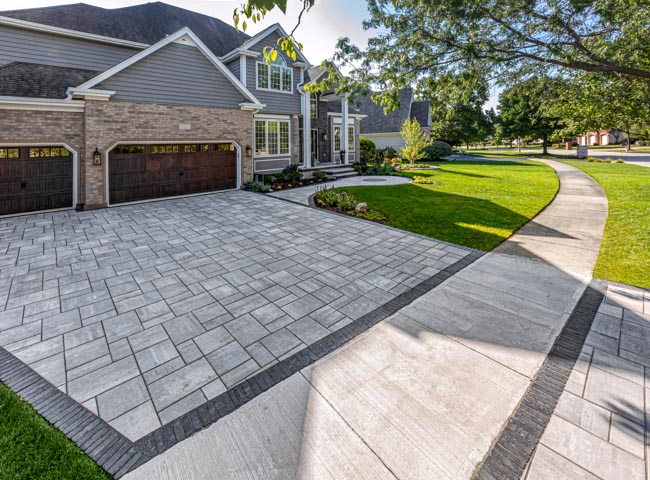
Concrete is not the only surface that benefits from sealing. Interlock driveways, patios, and walkways require their own maintenance approach. A proper interlock restoration includes deep pressure washing, re-sanding with commercial-grade polymeric sand, compaction and water activation, and then sealing.
Asphalt Driveways
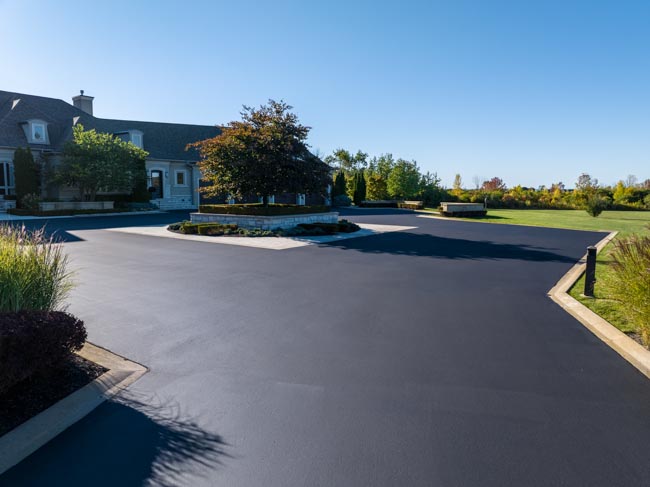
We also provide asphalt driveway sealing across the region. Asphalt sealing prevents oxidation, repels water, and dramatically slows surface deterioration — especially important in Hamilton’s freeze-thaw climate.
Our Don’t Pay Until You’re Satisfied Guarantee
Every job we complete at A.D.S. Wash & Seal is backed by our Don’t Pay Until You’re Satisfied guarantee. We do not take deposits. We complete the work, and then we ask for payment.
That structure is intentional. It means the only way we get paid is if the homeowner is happy with what they see. After 15 years working across Hamilton, Ancaster, Burlington, Waterdown, Dundas, Stoney Creek, Grimsby, and Beamsville, that guarantee reflects how we approach every job.
Get a Free Estimate
If your driveway or patio is showing signs of wear, fading, or surface damage, professional cleaning and sealing is almost always the right first step.
Call us at 905-515-2992 or visit our contact page to book your free estimate. Every job is backed by our Don’t Pay Until You’re Satisfied guarantee.
Frequently Asked Questions
How long does concrete sealing last in Hamilton?
Most concrete surfaces in Southern Ontario benefit from resealing every 2 to 3 years due to the combination of freeze-thaw cycles, road salt exposure, and UV wear.
Do you use the same sealer on all concrete surfaces?
No. Standard grey concrete gets a penetrating hydrophobic sealer. Decorative surfaces get a film-forming sealer that enriches colour. New concrete after 28 days gets a cure and seal product.
When is the best time to seal concrete in Hamilton?
Concrete sealing is best performed between late spring and early fall when temperatures are consistently above 10°C and the surface is fully dry.
Does sealing protect against road salt?
Yes. Sealing significantly reduces how much moisture and salt penetrate the surface, slowing erosion, pitting, and chemical breakdown over time.
What about new concrete — can it be sealed right away?
New concrete needs 28 days to cure before sealing. Sealing too early can interfere with the curing process and affect long-term strength.
Can you seal a driveway that already has cracks?
Yes. Hairline cracks do not prevent sealing from being effective. For more significant cracking, we assess during the estimate and give an honest recommendation.
What is your Don’t Pay Until You’re Satisfied guarantee?
We do not take deposits. We complete the full job and then ask for payment — you inspect the work before any money changes hands.
Do you work on commercial properties?
Yes. We service both residential and commercial properties across all communities we serve. Contact us to book a free in-person estimate.